Showing posts with label patterntology. Show all posts

07 June 2025

Tortoisix


First Edition 2025

I've only encountered a single desert tortoise, a memorable moment. My dog, Scout, investigated while we respectfully waited for the tortoise to emerge from its shell and continue its journey through the boulders. These creatures are masters of disguise, their dusty shells blending seamlessly with the scree. I'm especially pleased with the colorization in this piece, capturing the imposing, fortress-like rock formations and the distinctive mackerel clouds.


15 December 2024

Owlix


First Edition 2023

The manzanita, a botanical marvel, served as the primary inspiration for this work. Its mature form, characterized by gnarled branches and sharp angles, evokes the complex structure of the human brain. As the tree ages, certain portions undergo senescence, bleaching white as teak. However, vital red sections continue to nourish the living branches, ensuring the tree's survival. This unique adaptation, similar to the iconic Bristlecone Pine, underscores the tree's remarkable resilience and ability to withstand harsh environmental conditions

The Sky Islands' smallest raptor, the elf owl, is the spirit of the piece. Knowledge rests on the branches of the mind even as memory ages and falls/fails with age. A concept I'm familiar with as the years pass by. 

Partly through the colorization process. I like to think of it as an adult coloring book I make myself.


Pen and ink, digitally colored


25 September 2022

Monsoon Agavix


Monsoon Agavix

The Century Plant (living 20 to 30 years) is a low thick leaved agave found throughout the Sonoran Desert and bordering areas. As a desert plant, it's a significant landmark 6-10 feet around, and at the end of its life, putting forth a heroic asparagus-like stalk that branches and flowers to a height of 20-30 feet. This one iss in the backyard of my friend Richard Spelker and is vast and inspiring. 

I wanted a dramatic, rocky background, so I journeyed to the Dragoon Mountains, known for this sort of thing. I've never been to this area during the summer monsoon months, usually driving through on my way to Mt. Graham, where being outdoors in the shadow of pines is more tolerable. The area was bursting with life from more than 18 inches of summer rain filling ponds that dry up in the summer and growing grasses above your waist by the end of the season. Insect and reptile life was abounding as well as birds migrating by.

"Just add water" should be the tagline of this summer Eden. The grass dries out with a blonder cast to the landscape for the rest of the year. My framer recently saw a resemblance to William Wiley's work, which I first spotted at the Indianapolis Museum, making enough of an impression that I researched him. His checkered patterns and black lines resonated with my etching work, and I thought it appropriate to credit him in this piece. NASA's latest moonshot test rocket has these registration markers included, and it is a fitting metaphor for something that takes decades to charge up before blasting up and away.

Monsoon Agavix


08 January 2022

O. Apachex


Illustrating a freshwater fish in its natural habitat, in a natural pose other than the usual water splash caught in mid-air from the muscle-arched body lunging toward a mayfly, mouth agape; the fisherman's wet dream of a perfect strike. This pose presented an exciting challenge of depicting above and below water landscapes in the same piece.

Small canyons with streams and cool blue-green pools do exist in the Sonoran Desert. The endangered Apache Trout thrived here, but interspecies competition with the Spotted Trout, stocked by humans, has reduced its domain to 25 miles of the Gila River, smaller tributaries, and adjacent parts of New Mexico. A fly fisherman in my past life, I like to spend time with good fishing spots, although these days it's with a sketchbook and camera. I try to spot what I can through the ripples, but the real telltale signs of trout are tiny fly lures and the glisten of fishing line in unreachable branches of trees around.

The trout is a notoriously difficult catch for a fisherman due to the miracle of its vision. The trout eye is engineered to deal with light refraction through the water's surface and is sensitive enough to see insects above water by the dim light of the stars. The trout can also see you unless you are crafty enough to be outside of its wide cone of vision.

Although the Apache Trout is not a current resident of the Sonoran Desert, I felt it appropriate to include it in my series considering the conservation efforts to restock this rare and wonderful inhabitant of our desert.

Prints for sale at patterntology.com


11 September 2021

Amethyx


Ah, crystals. I know what you think when you see crystals. New Age guru was not my intention, though. I wanted to depict something mineral, if only one subject, to make a footnote in my work that the Sonoran Desert is a wellspring of gems, precious metals, and beautiful minerals. Given that, yearly, I'm steps from giant tents of vendors and prospectors selling their gems and minerals at the Tucson Gem & Mineral Show, I've become a fan. I also like following posts at the Mineral Database, considering I know very little about the field. I do know there are hidden treasures in hard-to-find places here.

Walking along the surface of the desert in hilly or mountainous areas, the possibilities below your feet are reality. Chambers of water, fault lines ever moving, cavities filled with mineral formations, and spelunkers are still discovering immense cave systems. It was hard to pick one thing from the ground that symbolized it for me. Copper, turquoise, and silver are actively mined here. Meteorite finds are commonplace, given visible craters and the ease of spying them in bare earth areas, so the extraterrestrial angle was interesting. In the end, I settled on Amethyst.

As volcanic lava cools, it traps pockets of gas and silica-rich liquid to form Quartz crystals. If the liquid has trace amounts of iron and you wait millions of years, you get the purple-hued Amethyst. There is a background overlay in my piece of a sequential nonrepeating pattern echoing quartz's hexagonal base structure and organic growth. (Also, somewhere in there are some coordinates.)

I can't ignore the labeling of crystals with spiritual significance. It exists for many people. I can't ignore the monetary value put on them either, but I do. To me, unseen secrets below the ground flesh out the detail of the terrain, mimicking the rarity of natural life on the surface. It makes perfect sense to me.

Prints for sale at patterntology.com.


Codex Sonora Printed


The whole process of inking prints and putting them up for sale to ultimately end up in a book is like releasing movie trailers until the movie comes out; only in my case, it was six years of trailers, including a pandemic. There's an elegance to this process that includes a pace keeping me interested and always working toward a final product.

The text is off-putting to some who either discount the whole book as nonsense or are discouraged by not reading it immediately. The other group finds an enchanting mystery in the document and even focuses enough to read it right away. It's funny to me that people are brutally honest about their opinion of something in book form. Still, if presented with something indecipherable in an art gallery, they walk away humbled, thinking they lack the sophistication or expertise. A psychological principle at work here about reactions to new things? I lack the sophistication or expertise to explain that principle!


I could create text that looks like a written language to suggest cipher code to be cracked (or not), but I do have thoughts about each piece while I build each piece. Text usually comes in list form derived from my observations and research I put into the subjects. The font I chose is of my creation called Quotasoon. I'm not sure if you would call this writing poetry or prose comprised of list-like terms or phrase snippets pulled from science writing that formed my understanding of the subject or phrases that encapsulate the subject's feeling and place. Maybe this is something akin to what an AI would do if using object-oriented philosophy. I read it off internally, as you might read:

"...doctors skilled in the treatment of diseases dormant in the black dust of ruined cities, gathering virulence in the white blood of eyeless worms feeling slowly to the surface and the human host, maladies of the ocean floor and the stratosphere, maladies of the laboratory and atomic war... A place where the unknown past and the emergent future meet in a vibrating soundless hum... Larval entities waiting for a Live One..."

― William S. Burroughs, Naked Lunch


17 May 2020

Sonoran Deserex


I am no expert on the Sonoran Desert; although I live here, and considering a majority of it exists inside of Mexico, which I have camped in about ten times, I'm familiar with the terrain. A few years ago, I did this 3d map of the 
Pineleño Mountains. Then there was the paleogeographic project I teamed up with a geologist to render the creation of the Gulf of California back to 10 million years. This time, I revisit the map as an art print and an essential part of my upcoming book.

There were a lot of decisions to make during this piece. How much texture, color, include roads, walls, cities, vegetation. Maps aren't maps without bathymetry, which tells the whole story IMO, especially in the gulf where the peninsula has peeled away from the mainland and is on it's way to Alaska. My spacecraft crashed here, and my information screen was on the fritz, and the power supply was waning, so I made some paper and ink and started tracing the screen to save the information.


03 January 2020

Speleox


Like the otherworldly biom of the Sky Islands in Southern Arizona, there is another world underground. Thinking about the natural world under our feet, I was inspired by Kartchner Carverns. By happenstance, I was hired to my year-old creative director job by Gary Tenen, co-discoverer and protector of the caverns that eventually became a state park.

The bat seemed a natural fit for this piece. Nesting below ground and hunting outside, no one is more aware of the advantages of cave life in the desert than the bat. Listening to recordings of it's high frequency echo locations, I felt some grunge. Flying through the choppy sound waves to navigate its way through cave chambers and out into the open air, the bat not only helps control insect populations but is integral in the pollination of desert plants.

My aim with these prints are to collect them into a book, "Codex Sonora." My next print will be a map of the Sonoran Desert and then I'll spend the next year working on the cover, text and layout of the book. I'm excited to finally make a book since starting this series in 2015, then it will be onto Volume 2!


13 July 2019

Apidaex


The last ice age pushed into the Sonoran desert and pushed out the Saguaro cactus and the Ironwood trees down to the middle of Mexico and replaced by Juniper forests and giant sloths. When the cold receded, the Saguaro came back to Arizona thousands of years faster than the Ironwood. Why? Birds. Birds can migrate hundreds or thousands of miles pooping seeds from the Saguaro fruit along the way. Ironwood seeds are eaten and pooped out by pack rats. Pack rats have small domains of a mile or more.

But first, plants need pollinators. In the desert these are bats, insects, and bees. They are genetic networkers for the plants they forage. They will forage up to 4 miles away and periodically, the whole hive will strike out and find a new place to resettle. Which makes me think of computer networks and networking software, site visits (like to a blog), and social media.

Insects with a queen are really one organism. Grouped together, I image a hive to be the size of a small dog. A small dog with 10,000 stingers. I've encountered a hive on the move while on the trail. I heard them before I saw them. I always give them space and respect because they can be aggressive. Our bees down here are Africanized, Africanized hybrids, aggressive, but are immune to the fungus that's killing bees elsewhere.


21 May 2019

Peregrix


The Peregrine falcon is a wide-ranging species and a seasonal migrator, but the Sonoran desert is one place it breeds and calls home all year round. I have some nesting near my office, and at break time in the back when the wind is flowing over the Tucson Mountains, one of them might kite slow and low over me to take a look. Then there's that sound effect Hollywood is so fond of.

Out in the desert, circling in long slow arcs among rock towers and dodging dust devils, birds have a different spacial reality than we do — especially the strong fliers of the predatory world. Looking up at them, we're like the bottom feeders of the sky sea.

In this piece, I was thinking about the layers of air being like floors in a multistory building. I see birds cruising for prey, but sometimes I see them way up there on the top floor, far beyond hunting zones, watching the curvature of the earth and soaring smoothly on thermals.


17 February 2019

Javelinix


The first time I heard of the javelina was during a horseback ride when the trail guide started describing a vicious black pig of the desert that would attack cattle and horses. The first time I saw a javelina he saw me and ran away. The second time I saw a javelina was in a parking lot. He was wandering around the cars and sniffing around trash cans.

Since those encounters, I happen upon them as a common occurrence on trails and try to keep my distance. Once during a dry spell, 3 large ones walked down my street like a gang of tough guys unafraid of the urban environment around them.

Most of the time I'm amazed the Sonoran Desert can support mammals this big and then remember this is a pretty green desert as far as deserts go. As a regional character, the javelina is pretty famous; adorning postcards, lawn ornaments and mailboxes. As a wild animal it's tough, crafty and fearless.

I was thinking about their sense of smell which is way better than their eyesight. That sense of smell helps them root out seeds, meats, fruits grasses and roots. A scent gland on the rear of their back help them communicate with each other. So yeah, I was thinking about navigating by smell in this piece.


13 November 2018

Canix

Canix

Coyote is cunning. Coyote is opportunistic. Coyote is curious. Coyote is a hardy survivor like the desert itself. This is why the coyote is feared and hated. Coyote is the brother of the wolf, and both are the oldest branches of the canine genetic tree.

I can't help seeing 'dog' when I encounter them. My reaction to them is always awe mixed with a little caution. A pack of three moved into an abandoned area near my house. Walking my dog Scout there one day, the coyotes approached. Scout played with one of them like they were puppies. I was amazed how they immediately turned to play. I swiveled around to see the other two carefully moving into a position to circle us. It might have been a defensive strategy but being out-numbered I tossed rocks to break up their plan. Another time I was hiking down a wash with Scout. A group of 8 came toward us. I called Scout next to me as the coyotes fanned out, slowing and sniffing as they passed, and went on their way.

The eyes and ears of the desert, they want to know who's coming and going. My piece has a coyote at dusk keeping an eye on the horizon, ears focused and nose scanning for changes in the air.

Canix

25 September 2018

Ocotillix Rosario

Ocotillix Rosario

In the Sonoran Desert, some areas get more rain than others. Around Tucson the yearly rainfall is 12" but in the El Pinacate y Gran Desierto de Altar it's closer to 3" if any at all.  Rain is usually randomly sourced by a Pacific hurricane or tropical storm coming inland to die. So hardy adaptive plants like the ocotillo growing in an area with less rain may look young but actually be very old.

How old? Sometimes more than 100 years old. Here's some interesting photos. Notice the cactus growth on the left and the relatively unchanged ocotillo on the right after 86 years.


From Desert Laboratory on Tumamoc Hill

In between rains, ocotillo dials its' metabolism down to a crawl and appears to be a bundle of dead, spiny sticks. When rains occurs it springs into action by sprouting leaves and bright red torch-like blooms. Pollinators like carpenter bees and hummingbirds are attracted to the blooms.

This one was found in the Gran Desierto de Altar at the foot of the Sierra del Rosario mountains. I was taken by the height of the ocotillos in this area compared to most of the shorter, ground-hugging plants and the sound of wind through their spiny branches.


Ocotillix Rosario


28 May 2017

AA Pinacate

AA Pinacate

The ancient feeling of the Pinacate Bioreserve surrounds you with its volcanic landscape of black cinder. Yet in all of the ancientness, the ʻAʻā (Hawaiian term) or rocky cooled lava looks as though it just happened yesterday. The lava flows are young, as in 40,000 years ago. Once molten and unapproachable, they are still a forbidding place to go. Massive piles of car sized ʻAʻā boulders, steep pits and a surface that is extremely sharp to the touch. Climbing among the lava flows must be done carefully because a misstep would mean certain injury. The going is so tough I've wondered if you tossed something into the center of the flow if it would ever be found again.

This piece was about getting into the detail of the rock and being true to it's nature. When you get into the details, it's more like working on an abstract piece. Natures abstraction pulls you into the details.

AA Pinacate

23 January 2017

Tarantulix

Tarantulix

Encountering a tarantula (this one is a Mexican Red-Kneed) always halts a hike for a dozen minutes or so. They seem so out of place but then you see how much sense their body design makes in the desert. I usually catch them crossing a clear area with comfortable purpose.

The eyes are tiny and not immediately apparent so it looks almost as if the furry automaton is feeling it's way through the landscape blindly or by some invisible force.

This is in fact the case. They sense the world around them more  through vibration and smelling pheromones than sight.

Right now it's safe to talk about Spider Grandmother under the webbed sky laced with stars because it's "the season when Thunder sleeps."

Tarantulix

27 September 2016

Mohavix

Mohavix

The Mohave Rattlesnake is the most venomous and hottest to strike of snakes in the Sonoran Desert. That being said, her symbiotic relationship with rodents is immeasurably important to the ecosystem. She's just doing her job very well.

With this piece I was thinking about margins and targets. Margins of the senses, margins of territory, margins of safety. Margins are breached by predator and prey. Territories filled with targets of seed bearing plants and rodent trails. Safety is staying outside the margins and sometimes below the ground's surface.  I imagine these invisible zones growing and shrinking from minute to minute as creatures hunt and hide. Plants set up slower seasonal margins of fruiting and flowering, as well as being a home to birds, lizards, insects and rodents. If you can see these invisible margins, you realize the dynamic interconnectedness of the desert biome.

Mohavix

18 July 2016

Lepus Allenix

Lepus Allenix

Meeting an antelope hare is like meeting a humble ambassador of the desert. A tall, slender running machine with long, alert ears always scanning. Their unusually large size has startled me more than once as I think there's a dog sitting there perfectly still. Maybe some type of greyhound. Creosote bushes are their perfectly-to-scale forest with plenty of room between bushes for multiple getaways. Heavily predated, they run, hide and breed with great proficiency.

There is something mysterious about the rabbits and hares. Not as much a sense of distrust but an inner alert and meditative wisdom. I was thinking about this stately way of being near the bottom of the food chain, it's strategy of multiple escape plans and it's zig-zag getaway move to throw predators off the trail.

Lepus Allenix

24 June 2016

Cereus Lunix

Cereus Lunix

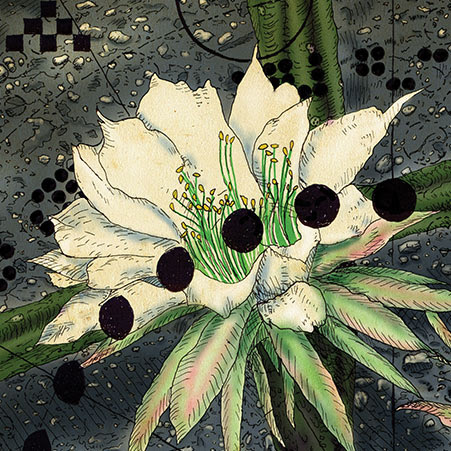
Every late spring in the Southwest there is great celebration centered around the night blooming cereus. There is a great variety including the Queen of the Night which blooms only once a year. Catching these lotus-like blooms on their special night is a real treat.
Blooming at night makes sense when your main pollinator is bats. The specimen depicted in my piece resides in my back yard. This succulent spreads out low along the ground, usually under shrubs or trees. It's not a Queen of the Night and blooms multiple times a year.

I was thinking about the tissue paper thin petals unfolding in the moon light, the first light to reflect back their pure whiteness. I was thinking about the timing of moon cycles and the quiet glowing shadows it bestows on the ground. Overlaid in the background is a target, personal space symbols and a dotted diagram of moon craters. This one came together nicely and was a fun one to do.

Cereus Lunix

20 March 2016

Islix Pinaleño


If you climb to a high elevation in the Southwest, besides the long unobstructed views, the flow of water over the landscape is pretty apparent. Arroyos (usually dry intermittent streams) fan out over the valleys like winding organic veins on their way downstream. This creates a beautiful fluvial fractalesque design. Multiple millennia of erosion. In this piece, I really wanted to express that texture.

Down here, mountains/mountain ranges are called "Sky Islands" (so... Islix). This is a section of the Pineleño range in southeast Arizona. Every biom from alpine to desert can be experienced hiking from top to bottom. They produce a lot of precipitation which races down into the valleys and that's when the infamous flash floods happen. Although, being the desert, they are usually dry and if you're hiking, you're most likely hiking in an arroyo.
Etching, 1987
It's funny that in my mid forties I'm doing work that most resembles work I did 27yrs ago in art school. I did a lot of etching back then, loved the black line, was fascinated with ruled lines, map markers and vaguely science-like notations. I've always liked that bird silhouette you find in bird identification books. I went through the flat files and found the last time I used that. Sometimes I wonder why I moved away from this work. I sold nearly every etching I made but thought that large scale abstracts were where it's at. Looking back, I can see how pure those etchings were. Truly my own. Well, it takes a long time to find yourself. The work I do now is truly my own.


21 January 2016

Calyptix - Node in the Genetic Desert Mesh

Hiking through the desert, the dull ring of silence may only be broken by the gravel crunching under your boots. Even if nothing seems to move you will undoubtedly encounter a hummingbird. You'll undoubtedly hear their high-pitched tweets.

In this piece I was thinking of a couple things. One, the bird's constant role as pollinator. Two, the maneuverability and miracle of it's hovering flight. Not to mention the iridescent ruby pink throat of Anna's Hummingbird. Wings flapping at twice the speed of any other bird with 360 degrees of vision  and energy enough to stay in flight for 50 minutes at a time. Imagine the invisible swirls of air currents churned up around it. The tiny squeaky chirp is the actual frame of the piece represented by the graphic sound waves you might find in an audio program.